
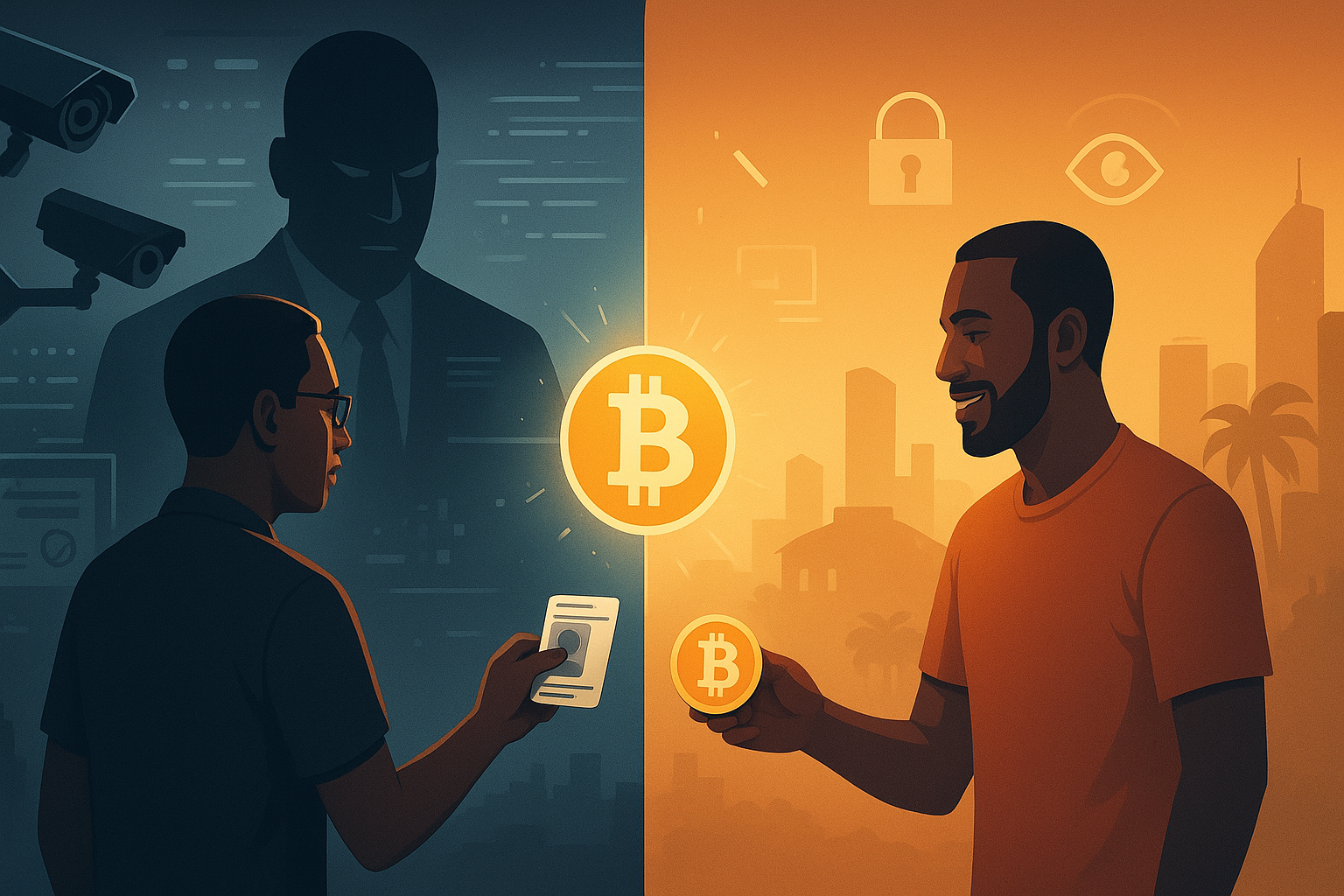
In 2021, after the Central Bank of Nigeria restricted banks from dealing with crypto exchanges, 28-year-old Tosin thought he had found a clever workaround: buy Bitcoin through a popular exchange that still operated locally, just upload his ID, take a selfie, verify his BVN, and he’d be good to go. “That’s the price of convenience,” he told himself. He wasn’t alone. Millions of Nigerians, from students to entrepreneurs, did the same.
But a year later, when political tensions grew, bank accounts were frozen across the country with shocking ease. Activists, journalists, and everyday Nigerians found themselves locked out of their own money. And for the first time, Tosin realized something uncomfortable, that by buying Bitcoin with his government-issued ID, he had unknowingly created a permanent, trackable link between himself, his financial choices, and the very institutions Bitcoin was meant to liberate him from.
That was the day he learned a hard truth:
In Bitcoin, the way you acquire it matters just as much as the fact that you own it.
The Illusion of Safety: What KYC Really Means
Most centralized exchanges require KYC (“Know Your Customer”) verification, uploading your ID, address, facial scan, sometimes even bank statements. It feels normal, almost harmless. But here’s the truth many only discover too late: KYC doesn’t protect you; it protects the institution collecting your data.
Once your identity is tied to your Bitcoin:
- Your holdings can be surveilled.
- Your transactions can be linked to you indefinitely.
- Your withdrawal patterns can be flagged.
- Your wallet addresses can be shared with third parties or government agencies.
- You can be restricted, blacklisted, or frozen without warning
In Nigeria, and across much of the Global South, citizens have lived this reality for decades. When institutions panic, they clamp down. When the government feels threatened, it acts swiftly. And when crises erupt, personal freedoms become negotiable. Tosin learned this the hard way during the 2023 anti-corruption protests. He had not done anything wrong, but because his exchange flagged “unusual withdrawals,” his account was frozen “pending review.”
His mistake?
He bought Bitcoin like he was opening a bank account.
He confused “convenience” with “freedom.”
Bitcoin Was Built for Pseudonymity, Not Permission
Bitcoin’s core value is pseudonymity, not anonymity, and not exposure. A pseudonymous system is one where the network knows the address involved in a transaction, but not the real person behind it. And that matters because in places like Nigeria, where currency instability, inflation, and arbitrary financial restrictions are everyday realities, pseudonymity is not a luxury, it’s protection. When you buy Bitcoin by handing over your ID, you undo this protection at the very first step. Your first impression on the blockchain is no longer pseudonymous, it’s officially tied to you forever.
This isn’t just about privacy, it’s about power.
If money is the ability to act, then surveillance is the ability to stop you from acting.
The Custodial Trap: “Not Your Keys, Not Your Coins”
Many Nigerians assume the exchange where they bought Bitcoin is a “wallet.”
It isn’t. That’s a custodial honeypot, where your assets can be:
- frozen during political unrest
- seized during regulatory crackdowns
- lost in a hack
- blocked by a third party with “compliance concerns”
- drained in insolvency (as FTX and others proved painfully)
Owning Bitcoin through a custodial exchange is like owning land with the landlord holding the only key to the gate. You’re a tenant, not an owner. True ownership starts the moment you hold the keys yourself, and only if your identity isn’t already stamped onto every transaction you make.
Tosin’s Turning Point: Discovering P2P Without KYC
After his account freeze, Tosin finally understood what Bitcoiners meant when they said: “The revolution isn’t Bitcoin. The revolution is being able to acquire Bitcoin without permission.”
A friend introduced him to Vexl, a decentralized, peer-to-peer platform that enables people to acquire Bitcoin privately, without KYC, without a central authority, and without custodians holding their coins hostage.
Here’s why Vexl became his go-to:
- No ID Required: No uploads, no face scans, no BVN. Your financial life stays yours.
- Pure Peer-to-Peer Matching: Humans connecting with humans, no central order book, no database to be hacked, leaked, or weaponized.
- Built for Privacy and Security: Encrypted messaging, no central servers tracking behavior, and no institution able to freeze or reverse your trades.
- You Hold the Keys: From the moment Bitcoin lands in your self-custodial wallet, it is yours.
Not your banks. Not an exchange. Not the governments.
For Tosin, using Vexl wasn’t about “hiding.” It was about reclaiming financial autonomy.
Why This Matters for the Global South
People in the West often debate privacy as a philosophical luxury.
But in Nigeria, Ghana, Kenya, South Africa, Zimbabwe, Venezuela, Argentina, and beyond…
- privacy is survival
- pseudonymity is protection
- and permissionless finance is empowerment
In regions where governments routinely freeze accounts, cap withdrawals, restrict forex access, and surveil transactions, Bitcoin isn’t an investment. it’s an exit. But only if you acquire it the right way.
The Real Lesson: Your First Steps Decide Your Freedom
When you buy Bitcoin with your ID, you’re not just giving up privacy, you’re giving up leverage. You’re creating a permanent file that links you to every sat you own.
But when you buy Bitcoin privately, through peer-to-peer platforms like Vexl, you regain what Bitcoin was designed to offer:
- Choice
- Control
- Freedom from surveillance
- True ownership
Tosin’s story is becoming more common, the lesson is becoming clearer, and the next generation of Nigerians, and Africans at large, are increasingly choosing to acquire Bitcoin the way it was meant to be acquired:
- Without permission.
- Without surveillance.
- Without regret.
Final Takeaway
Buying Bitcoin isn’t enough. buying it the right way is what protects you.
In a world where financial systems can turn on you overnight, your ID should never be the key that unlocks your future, or the chain that restricts it.
Vexl gets this, and platforms like it are quietly shaping the future of Bitcoin in the Global South, because financial freedom doesn’t start with Bitcoin, it starts with how you get it.